

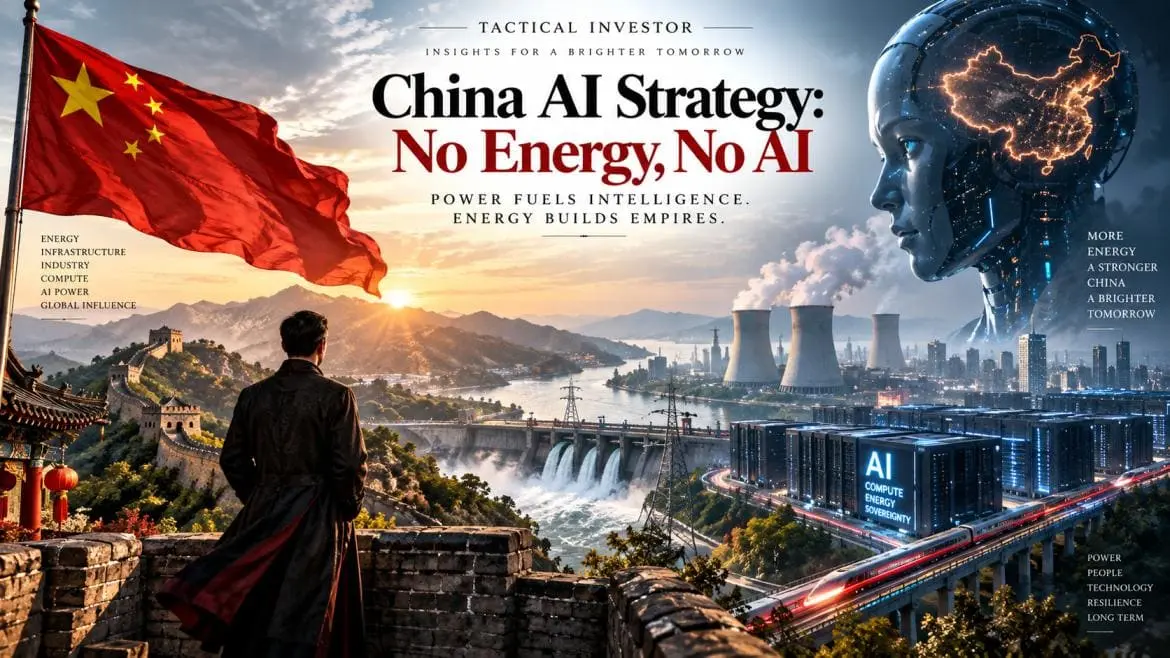
China AI Strategy: Energy Is the AI Strategy
Sept 15, 2026
From Diesel to AI: Following the Changing Competitive Landscape
Things on the geopolitical frontier continue to move at extraordinary speed. One minute it appears that Trump is suggesting negotiations, and hours later the situation appears to move in the opposite direction. Whether that approach is right or wrong is a separate discussion, because from a vector perspective there are several forces moving simultaneously, and in this case, diesel is one of them.
U.S. refineries depend heavily on access to heavier and sour grades of crude, much of which historically comes from regions now facing disruption. Higher oil prices are one problem, but diesel is particularly important because it filters directly into transportation, agriculture and industry, meaning higher diesel prices hit farmers and other energy-intensive sectors especially hard. What looks like an energy problem therefore quickly becomes a cost problem across the broader economy.
Why Venezuela Matters
Perhaps this helps explain the rush to secure larger oil arrangements with Venezuela. However, Venezuela’s oil infrastructure has deteriorated badly, and meaningful increases in production will require substantial investment and time. A multibillion-dollar announcement may sound impressive, but it does not suddenly produce millions of additional barrels tomorrow because the infrastructure has to be rebuilt first.
Unless there is a meaningful break in the current impasse, higher fuel prices, particularly for diesel, may become something consumers and businesses simply have to adapt to. That creates an interesting second-order effect because the longer elevated diesel prices persist, the stronger the economic incentive becomes to find alternatives. This is where the energy story begins to intersect with China’s industrial strategy.
China Is Building the Alternative
China has been moving aggressively into electric heavy machinery, including agricultural equipment. As battery technology, manufacturing scale and supply chains improve, the economics become increasingly attractive, while China’s control over a substantial portion of the manufacturing ecosystem behind the transition gives it another structural advantage.
Chinese farmers are increasingly escaping the full impact of rising diesel prices by switching parts of their operations to battery-powered machinery, including electric tractors, harvesters, cultivators, sprayers and autonomous farm equipment. In some applications, direct energy costs can fall dramatically, with one Chinese electric combine demonstration reporting electricity costs of under ¥1 per mu, roughly 14 U.S. cents, compared with ¥14 to ¥20, or approximately $1.95 to $2.80, for conventional fuel-powered equipment.
That difference matters because it is not simply about replacing one machine with another. Battery swapping, cheaper electricity and expanding farm automation can reduce operating costs simultaneously, while autonomous equipment can also reduce labour requirements. If diesel remains expensive, the economic pressure to make this transition becomes stronger, creating a feedback loop between energy prices, electrification and industrial competitiveness.
The China AI Strategy Runs Through Energy
There is another important development on the energy front. Solar has now overtaken coal as China’s largest source of installed power capacity, although that does not mean solar currently produces more electricity than coal because coal remains dominant in actual generation. The distinction is important, but so is the direction of travel because China’s enormous expansion of power generation and renewable capacity gives it a growing structural advantage as electricity demand rises.
Electricity costs add another layer to this advantage. Roughly speaking, many Chinese users pay around 6 cents per kilowatt-hour, with costs generally ranging from approximately 5 to 9 cents depending on the region, customer and level of subsidy. Industrial users in some regions can obtain electricity toward the lower end of that range, giving China a significant cost advantage in energy-intensive manufacturing and infrastructure.
By comparison, average residential electricity costs in the United States are roughly 18 cents per kilowatt-hour and can be considerably higher in certain states. The precise comparison varies because industrial, commercial and residential electricity prices are not interchangeable, but the broader point remains important: electricity is becoming an increasingly important competitive input.
AI data centres, robotics, advanced manufacturing and automation all consume enormous amounts of power. China is therefore not merely producing more electricity; it is building the generation capacity, manufacturing base and infrastructure required to support industries whose appetite for power is accelerating.
That is an important part of understanding the China AI strategy. The competition is not occurring inside a laboratory where the only variable is the intelligence of a model. It is occurring across the entire industrial stack, from electricity generation and semiconductor manufacturing to data centres, robotics, batteries, transportation and automated production.
AI Is Becoming a Cost War
This brings us back to AI. Axios recently argued that China’s rapid progress has erased America’s commanding lead in advanced AI, citing Kimi K3’s near-frontier performance and substantially lower costs. Whether that assessment ultimately proves permanently correct is not the important issue.
The important development is that the competitive gap has narrowed dramatically, while the nature of competition is changing. The AI war is increasingly becoming a battle over price, accessibility and deployment costs, rather than simply who can produce the most impressive benchmark.
That distinction could become extremely important. If companies can obtain near-frontier performance at significantly lower cost, the economics surrounding massive AI infrastructure spending begin to change. U.S. companies then have to justify higher costs for chips, electricity, infrastructure and highly skilled labour while competing against an ecosystem increasingly capable of offering cheaper alternatives. This does not mean the United States suddenly loses its technological advantage. It means the definition of technological advantage is changing.
The Moat Is Under Pressure
A technological moat is valuable when competitors cannot reproduce the underlying capability at a comparable cost. Once competitors begin producing similar results more cheaply, however, the moat starts to narrow even if the original technology remains superior.
This is why the China AI strategy deserves attention beyond the usual debate over which country has the best model. China’s potential advantage is increasingly tied to the combination of cheap energy, enormous manufacturing capacity, electrification, automation, infrastructure and the ability to deploy technology at scale.
The pieces reinforce one another. Cheap electricity supports industrial production and data centres. Industrial scale lowers manufacturing costs. Lower costs accelerate electrification and automation. Automation increases productivity, while greater AI deployment creates additional demand for electricity and infrastructure. That is a feedback loop.
Follow the Vector, Not the Headline
The mistake investors can make is looking at each development separately. Diesel prices appear to be an energy story, Chinese electric tractors appear to be an agricultural story, solar capacity appears to be an energy-transition story, and AI models appear to be a technology story.
They are not necessarily separate stories. They are different expressions of the same competitive vector. The question is therefore not simply whether China has caught up with America in AI, because that framing is too narrow. The more important question is whether China is constructing an industrial environment in which AI can be deployed more cheaply, more broadly and more efficiently than its competitors.
If that vector continues strengthening, the implications extend far beyond AI companies. They reach into energy, semiconductors, batteries, robotics, heavy machinery, data centres and advanced manufacturing. The competitive landscape is changing underneath the headline, and investors who focus only on the headline may miss where the real advantage is accumulating.
The moat does not disappear overnight, but moats weaken when competitors begin producing comparable results at a lower price. That is the development worth watching, and the China AI strategy may ultimately be less about winning the AI model race than building the cheapest industrial ecosystem in which AI can operate.