
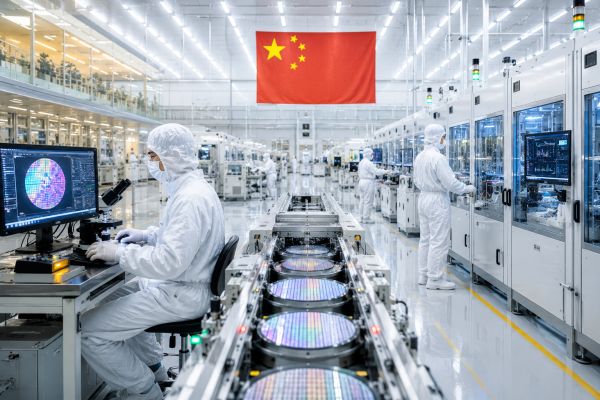
China’s Real Challenge Isn’t Building the Best Chip. It’s Building the Strongest System.
Jun 5, 2026
For years, analysts have asked the wrong question.
Can China build the world’s best chip?
That question generates headlines, but it may no longer be the most important one.
The better question is this:
Can China build the world’s most capable industrial and technology system?
Those are very different competitions.
The first focuses on individual products. The second focuses on the entire ecosystem that produces those products. History suggests ecosystems often matter more than individual breakthroughs.
Most investors instinctively focus on the visible trophy. The fastest chip. The smallest transistor. The highest benchmark score. Yet industrial leadership rarely emerges from one product. It emerges from the ability to build, scale, refine, and continuously improve entire systems over long periods.
That distinction matters because China has followed a remarkably consistent playbook across multiple industries.
The Pattern Keeps Repeating
The story is familiar.
At first the industry dismisses China as a low-cost producer.
Then manufacturing scales.
Costs fall.
Engineering improves.
Supply chains deepen.
Domestic demand expands.
Eventually parity arrives.
After that, competitors discover they are operating inside a much tougher environment than they expected.
We’ve seen this pattern repeatedly.
Solar panels were once viewed as a commodity business where Chinese firms merely copied existing technology. Today China dominates global production.
Electric vehicles were supposed to remain years behind Western competitors. Today China operates the world’s largest EV ecosystem.
Shipbuilding followed a similar path. What began as low-end volume production eventually became global leadership by output.
The same progression appeared in batteries, telecommunications equipment, critical minerals processing, and numerous industrial sectors.
The starting point was rarely technological superiority.
The advantage came from scale, persistence, manufacturing depth, and the ability to improve relentlessly over time.
That is what many investors still underestimate.
Why Semiconductors Are Different
At the same time, it would be a mistake to assume every industry follows exactly the same script.
Semiconductors are not solar panels.
Advanced lithography remains one of the most complex engineering achievements in modern history.
There is a reason companies like ASML continue to attract so much attention.
The challenge is not simply building a machine.
The challenge is recreating decades of accumulated expertise, specialized supplier relationships, precision optics, advanced materials science, and manufacturing knowledge that exists throughout the ecosystem.
Money alone does not solve those problems.
Neither does political will.
Some bottlenecks exist because they represent thousands of tiny advances accumulated over decades.
That is why anyone assuming China automatically catches up in every sector should exercise caution.
History supports adaptation.
History does not guarantee identical outcomes.
The Market Share Trap
Another mistake investors often make is confusing market dominance with economic dominance.
The two are not always the same thing.
China has achieved enormous market share in several industries while profitability remained surprisingly thin.
Solar manufacturing offers a perfect example.
The industry became globally dominant, but competition often compressed margins to levels many Western investors found unattractive.
The EV sector exhibits similar characteristics.
Competition inside China is fierce.
Companies battle aggressively for market share.
Some gain scale while destroying profitability in the process.
Market share creates headlines.
Returns on capital create wealth.
The distinction matters.
Investors who focus only on volume often miss the underlying economics.
The Variable That Changes Everything
The most important factor may not be chips, sanctions, or government policy.
It may be the combination of four forces operating simultaneously:
Engineering talent.
Capital investment.
Manufacturing capability.
Domestic market size.
Most countries possess one or two of these advantages.
Germany has exceptional engineering talent.
Japan possesses deep manufacturing expertise.
India produces large pools of technical talent.
The United States maintains world-class capital markets and frontier research capabilities.
China combines all four at considerable scale.
That creates something far more powerful than any individual breakthrough.
It creates a feedback loop.
Large domestic markets generate revenue.
Revenue funds research and development.
Research improves products.
Improved products capture additional market share.
Growing market share generates more revenue.
Then the cycle repeats.
At first progress appears slow.
Then suddenly observers claim it happened overnight.
In reality the groundwork was being laid for years.
The crowd simply failed to notice until the outcome became impossible to ignore.
Why Investors Need a Different Framework
Ten years ago, many investors operated under a simple assumption.
China manufactures.
The West innovates.
That framework is becoming increasingly difficult to defend.
The evidence now suggests China is becoming capable of doing both.
That does not mean China automatically wins every technology race.
It does mean the probability distribution has changed.
And that is where many market participants fall behind.
Markets rarely move when certainty arrives.
They move when probabilities change.
The biggest investment opportunities often emerge when old assumptions stop working but new assumptions have not yet become consensus.
That is the phase we may be entering now.
The Semiconductor Race May Be Changing
This brings us back to semiconductors.
Many analysts remain focused on whether China can produce the world’s smallest transistor.
That may be the wrong battlefield.
The industry itself has already begun shifting toward advanced packaging, chiplets, memory integration, optical interconnects, software optimization, and system-level efficiency.
In other words, the competition is becoming broader.
The winner may not be whoever builds the smallest transistor.
The winner may be whoever builds the most efficient system.
That shift favors scale, manufacturing depth, engineering talent, and supply-chain integration.
Areas where China continues to improve.
The Bigger Picture
If China eventually achieves:
• 80-90% of frontier performance
• Lower production costs
• Massive manufacturing scale
• Integrated domestic ecosystems
• Acceptable yields
Then many countries may adopt Chinese technology infrastructure regardless of whether it remains technically the absolute best.
History shows industrial leadership often shifts this way.
Not through immediate superiority.
Not through one revolutionary breakthrough.
Through scalable sufficiency.
Good enough becomes cheap enough.
Cheap enough becomes dominant enough.
And dominant enough eventually reshapes the market.
That is how many industrial revolutions unfold.
The crowd waits for a dramatic moment when one side clearly wins.
Reality tends to move differently.
The advantage accumulates quietly.
Scale builds.
Costs fall.
Capabilities improve.
Then one day the crowd looks up and discovers the landscape changed while it was busy arguing about who had the better headline.
That possibility, more than any single chip announcement, is what investors should be watching.
China semiconductor strategy is about scale, systems, and industrial strength, not just building the world’s best chip.