
Charting the Rhythm of Stock Market Cycles
Aug 26, 2026
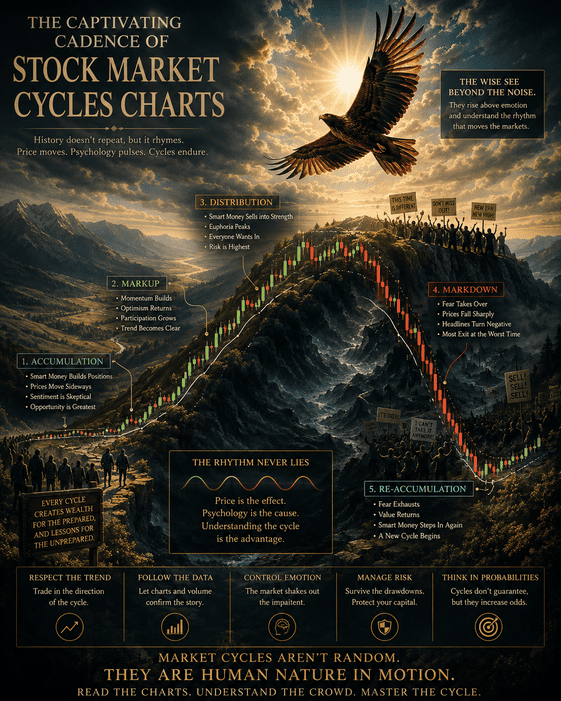
A stock market cycle chart is useful not because it predicts the future, but because markets repeatedly move through recognisable psychological phases. Fear, greed, optimism and panic alter behaviour, creating patterns that technical analysis can measure and mass psychology can help explain.
Warren Buffett captured the broader principle when he observed that markets transfer wealth from the impatient to the patient. The cycle matters, but understanding how investors behave within it matters more.
Benjamin Graham, the father of value investing, focused on the gap between price and intrinsic value. Markets can become wildly enthusiastic or deeply pessimistic, yet neither extreme necessarily changes what an asset is worth. That distinction matters because a cycle can distort perception long before reality catches up.
Mass Psychology and Stock Market Cycles
Peter Lynch’s observation that the key to making money in stocks is often simply avoiding being scared out of them points directly to the role of mass psychology. Investors do not merely respond to markets; their collective reactions help create the very movements they later fear or chase.
George Soros took this further through his theory of reflexivity, which describes the feedback loop between perception and reality. Rising prices can strengthen confidence, attracting more buyers and pushing prices even higher, while falling prices can trigger the opposite process. Markets therefore do not simply reflect psychology; psychology can reinforce the trend until excess eventually collides with reality.
Technical Analysis and Stock Market Cycles
John Templeton’s description of bull markets being born on pessimism, growing on scepticism, maturing on optimism and dying on euphoria captures the psychological rhythm behind market sentiment. Technical analysis cannot eliminate uncertainty, but it can help identify when momentum, participation and sentiment are beginning to shift.
Philip Fisher understood the danger of confusing price with value, while Jesse Livermore offered an equally important warning: the market is never obliged to respect your opinion. Technical analysis is therefore most useful not as a prediction machine, but as a way of observing what the market is actually doing rather than what you believe it should do.
Cognitive Bias and Stock Market Cycles
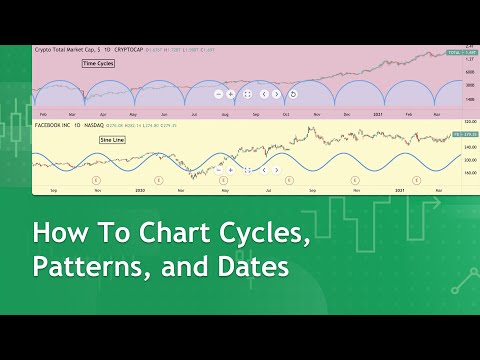
Jim Simons, the founder of the successful hedge fund Renaissance Technologies, has pioneered using quantitative analysis and machine learning in the financial markets. His approach highlights the potential of technical analysis to uncover hidden patterns and opportunities, transcending the limitations of human cognition and the biases that can influence the perception of stock market cycles.
Carl Icahn, the renowned activist investor, has emphasized the importance of overcoming cognitive biases, stating, “I try to buy stocks that are undervalued and sell them when they become overvalued.” This perspective challenges the notion that stock market cycles are entirely predictable, as cognitive biases can lead investors to make suboptimal decisions.
Ray Dalio, the founder of Bridgewater Associates, has explored the concept of “radical transparency” in his investment approach, which aims to identify and mitigate the impact of cognitive biases. As he aptly observed, “The biggest mistake investors make is to believe that what happened in the recent past is likely to persist.”
Combining Mass Psychology and Technical Analysis to Win in Stock Market Cycles
The strategic combination of mass psychology and technical analysis can give investors a powerful edge when navigating stock market cycles. Mass psychology highlights the collective behaviour of investors, often leading to market overreactions, while technical analysis identifies patterns in price movements that can signal the next stage in a cycle. By understanding these two forces together, elite investors can position themselves ahead of market shifts.
George Soros’ theory of reflexivity is a prime example of integrating mass psychology and technical analysis. Reflexivity suggests that investors’ perceptions affect market fundamentals, reinforcing those perceptions and creating feedback loops. For instance, during the 2008 financial crisis, Soros recognized the mass fear gripping markets and identified the technical signs of a coming downturn, enabling him to make profitable trades by shorting assets before the collapse.
Jesse Livermore, one of the greatest traders in history, also famously utilized a blend of psychological and technical insights. He observed how emotions, such as greed and fear, consistently led to predictable patterns in the market, allowing him to capitalize on stock price swings. His advice, “The market is never wrong; opinions often are,” underscores the value of combining technical signals with mass psychology for better decision-making during volatile market phases.
Citing Examples of Successful Stock Market Cycles
Several legendary investors have demonstrated the value of identifying and capitalizing on stock market cycles. One such example is Carl Icahn, the activist investor known for his ability to time his trades based on market cycles. Icahn focuses on undervalued stocks that have the potential to rise through the stages of a market cycle. A notable instance was his investment in Apple during its low periods. Icahn’s entry into the stock before its explosive growth reflected his skill in recognizing cyclical opportunities within a company’s growth trajectory.
Another example is Paul Tudor Jones, a hedge fund manager who made his name by correctly predicting the 1987 stock market crash. He used technical indicators, like the 200-day moving average, combined with an understanding of mass psychology to anticipate the market’s sharp drop. His adaptive strategy showcases the importance of reading market cycles through technical and emotional lenses. By aligning his trades with major turning points, Jones protected his portfolio from massive losses and profit during one of the most volatile periods in financial history.
These examples emphasize how successful investors use a blend of patience, market analysis, and an acute understanding of cycles to outperform over the long term.
Integrating Expertise and Insights
John Bogle, the founder of Vanguard and a pioneer of index investing, has long advocated for maintaining a long-term perspective and avoiding the temptation of short-term thinking. As he eloquently stated, “Don’t look for the needle in the haystack. Just buy the haystack!”
Charlie Munger, the vice chairman of Berkshire Hathaway and Warren Buffett’s longtime partner, has emphasized the importance of a multidisciplinary approach to investing, stating, “The best thing a human being can do is to help another human being know more.”
David Tepper, the founder of Appaloosa Management, has highlighted the significance of understanding macroeconomic factors and their impact on stock market cycles, noting, “The market is a reflection of the economy, and the economy is a reflection of the market.”
William O’Neil, the founder of Investor’s Business Daily, has championed technical analysis in identifying market trends, asserting, “The market does not make mistakes, but it can get carried away with emotion.”
Paul Tudor Jones, the renowned hedge fund manager, has emphasized the importance of adapting to changing market conditions, stating, “The ability to anticipate the market’s reaction to news is the single most important skill a trader can have.”
By integrating the insights and wisdom of these esteemed experts, we can gain a deeper understanding of the complexities and nuances of stock market cycles. This holistic approach provides a powerful framework for navigating the ever-evolving landscape of financial markets and unlocking the potential for informed and strategic investment decisions.