
How the Roaring Twenties and Events Leading Up to 1939 Changed America Forever: Insights from Contrarian Investing
Sept 10, 2026
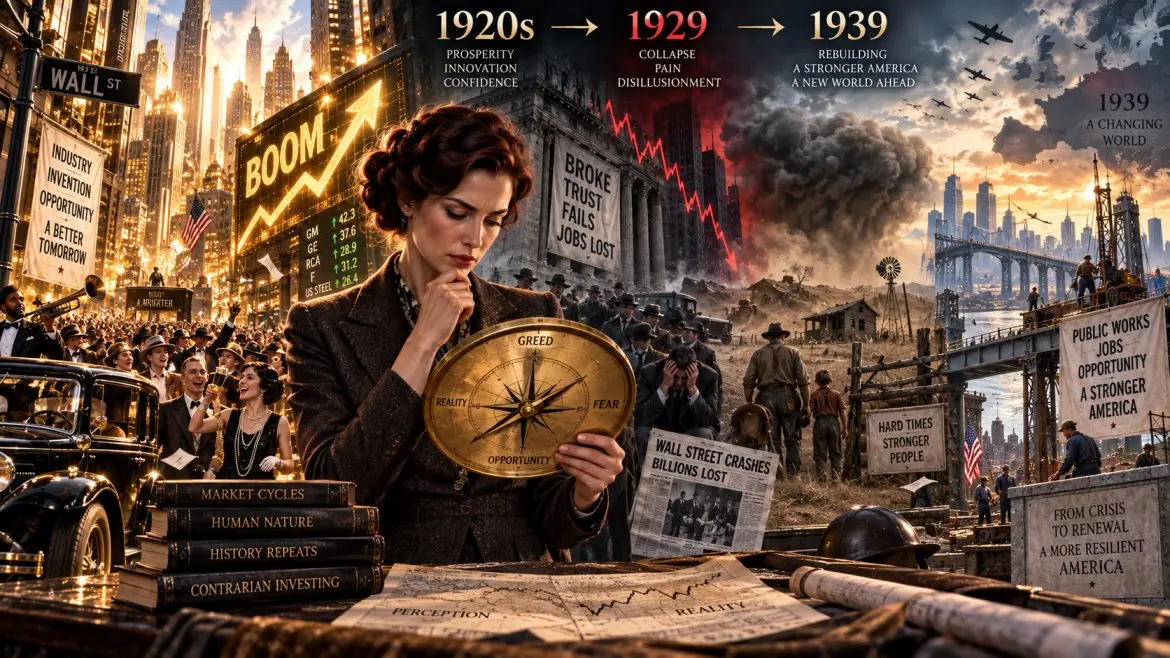
The Roaring Twenties were a remarkable period in American history, defined by economic expansion, technological innovation, cultural transformation, and a stock market that appeared capable of producing effortless wealth. Jazz filled the cities, automobiles and household appliances transformed daily life, and participation in the stock market expanded rapidly as Americans became convinced that prosperity had entered a new and permanent phase. Beneath that confidence, however, a familiar force was gathering strength: mass psychology.
When markets rise for long enough, people gradually stop questioning why prices are rising and begin assuming that rising prices themselves are proof that the underlying thesis is correct. That transition is important because it marks the point where investment becomes increasingly dependent on crowd behaviour rather than valuation, analysis, or discipline. The Roaring Twenties therefore provide one of history’s clearest demonstrations of how optimism can become self-reinforcing, how speculation can overwhelm fundamentals, and how the same crowd that drives prices to absurd levels can eventually drive them to equally absurd lows.
The Roaring Twenties and the Psychology of Excess
The 1920s produced genuine economic progress, but genuine progress does not automatically justify unlimited valuations. Investors increasingly bought stocks on margin, allowing relatively small amounts of capital to control much larger positions, while the prevailing narrative suggested that technological innovation and economic growth had fundamentally changed the rules of investing.
This was classic herd mentality. Investors saw others making money, interpreted those gains as evidence that the market was safe, and then increased their own exposure, which pushed prices higher and reinforced the original belief. The process created a psychological feedback loop in which rising prices generated confidence, confidence generated additional buying, and additional buying was interpreted as confirmation that the optimism had been justified all along.
The critical mistake was not optimism itself. The mistake was assuming that a powerful trend could continue indefinitely simply because it had continued for a long time. Markets do not reward belief indefinitely, and eventually valuation, liquidity, psychology, or some combination of the three forces the crowd to confront reality.
The Crash of 1929: When Confidence Became Fear
The October 1929 crash shattered the belief that prosperity and rising stock prices were permanent. The Dow Jones Industrial Average suffered extraordinary losses, and the subsequent economic contraction became one of the defining catastrophes of modern American history.
Yet the crash itself should not be viewed as a single event that magically created the Great Depression. The economic problems that followed were deeper and more complex, involving banking failures, monetary contraction, declining demand, debt, unemployment, and policy responses. What the market crash demonstrated with exceptional clarity was the speed with which mass psychology can reverse direction once confidence breaks.
The same investors who had previously feared missing the next opportunity suddenly feared losing everything. Optimism became anxiety, anxiety became panic, and panic became indiscriminate selling. This is precisely why the study of recency bias matters: investors often extrapolate the immediate past into the future, believing that what has just happened will continue indefinitely, whether that means stocks will rise forever or collapse forever.
Jesse Livermore’s success during the 1929 decline illustrates another important principle. He had built his reputation through speculation and technical analysis and successfully positioned himself for the major decline, but his later financial history also demonstrates that correctly identifying a market direction is not enough. Risk management and psychological discipline ultimately matter more than being right about one spectacular move. That distinction is frequently overlooked because financial history tends to celebrate the prediction rather than the process.
The Great Depression and the Birth of Contrarian Opportunity
The Great Depression created conditions that were almost the mirror image of the late 1920s. Instead of excessive optimism, investors confronted despair, distrust, unemployment, collapsing businesses, and widespread fear about the future.
This is where the contrarian principle becomes particularly powerful. When the crowd is euphoric, assets can become detached from reasonable expectations. When the crowd becomes terrified, the same mechanism operates in reverse, causing perfectly viable businesses and productive assets to be priced as though their future has already been destroyed.
Benjamin Graham built much of his investment philosophy around precisely this distinction between price and value. The market’s opinion could become wildly pessimistic without permanently destroying the underlying earning power of every company being sold.
That does not mean every depressed stock becomes a bargain. A falling price can represent genuine deterioration, bankruptcy, or permanent impairment, which is why contrarian investing is not simply buying whatever has fallen the most. The objective is to identify situations where the crowd’s emotional reaction has become substantially more extreme than the underlying reality.
John Templeton and the Power of Acting When Others Cannot
One of the most famous examples came in 1939, when John Templeton invested $100 in each of 104 companies trading below $1 on the New York Stock Exchange. Many were distressed businesses, and some ultimately failed, but the majority survived and appreciated substantially.
The significance of the trade was not that Templeton possessed supernatural forecasting ability. It was that he understood something the crowd had temporarily forgotten: extreme pessimism can create extreme mispricing.
By 1939, investors had spent years experiencing economic catastrophe, so the psychological environment was radically different from the exuberance of the late 1920s. Templeton was willing to buy when confidence was scarce, which is precisely when valuations can become most attractive.
This is the recurring pattern that contrarian investors should study. The crowd tends to become most optimistic after prices have already risen dramatically and most pessimistic after prices have already collapsed dramatically. The contrarian does not need to predict the exact turning point. The objective is to recognize when psychology has pushed the market far enough away from reasonable valuation to create an asymmetric opportunity.
Mass Psychology Creates the Opportunity
Markets are not merely discounting mechanisms driven by spreadsheets. They are social systems populated by human beings who experience fear, greed, confirmation bias, recency bias, loss aversion, and the powerful desire to belong to the majority.
During the late 1920s, those forces pushed investors toward greater risk because everyone appeared to be getting richer. During the Depression, the same psychological machinery operated in reverse, encouraging investors to assume that economic disaster would continue indefinitely.
This is why herd mentality remains relevant nearly a century later. The technology changes, the financial instruments change, and the economic circumstances change, but human behaviour changes remarkably slowly.
The important lesson is therefore not simply that markets crash. Markets have always crashed and always will. The important lesson is that crashes and crises can create extraordinary opportunities when emotional selling becomes disconnected from fundamental reality.
What 1929 Really Teaches Modern Investors
The period from the Roaring Twenties through 1939 permanently changed America’s financial system and its investment culture. The Securities Act of 1933 and Securities Exchange Act of 1934 established a new regulatory framework, while the trauma of the Depression profoundly influenced how Americans viewed banks, markets, debt, speculation, and financial risk.
For investors, however, the deeper lesson is psychological rather than regulatory. The 1920s demonstrate what happens when optimism becomes excessive, 1929 demonstrates how rapidly confidence can become fear, and the Depression demonstrates how that fear can eventually create valuations that bear little relationship to the emotional narrative dominating the crowd.
That sequence has repeated many times since then. The technology bubble, the financial crisis, the COVID panic, and other major market dislocations each contained different economic circumstances, but the psychological progression was remarkably similar: confidence, complacency, disbelief, fear, panic, capitulation, and eventually recovery.
This is why contrarian investing should never be reduced to simply doing the opposite of everyone else. The crowd can occasionally be correct, and a contrarian who automatically opposes consensus can become just as irrational as the crowd itself. True contrarian thinking means understanding the dominant narrative, identifying where psychology has reached an extreme, measuring that extreme against valuation and fundamentals, and then acting when the risk-reward equation becomes unusually favourable.
The Real Lesson From the Roaring Twenties
The greatest lesson from the years leading to 1939 is not that investors should fear another 1929. It is that investors should understand what happens when mass psychology overwhelms judgment. The Roaring Twenties demonstrated how prosperity can create overconfidence, 1929 demonstrated how quickly confidence can evaporate, and the Depression demonstrated how fear can become so powerful that investors eventually sell assets at prices that would have appeared unimaginable during the preceding boom. The investor who understands this cycle does not worship the crowd during euphoria or run from the market during panic.
This is the essence of the Tactical Investor approach: the opportunity often appears when the crowd becomes most emotional. Crises are not automatically bullish, and falling prices do not automatically make an asset attractive, but when quality assets become heavily discounted because fear has overwhelmed rational analysis, the crisis itself can become the source of the opportunity.
The investor’s greatest advantage is therefore not superior prediction. It is preparation, discipline, valuation awareness, and the psychological ability to act when everyone else is incapable of doing so. History does not repeat perfectly, but human emotional behaviour repeats with remarkable consistency. The Roaring Twenties and the years leading to 1939 changed America forever, but they also left investors with a lesson that remains as relevant today as it was then: when the crowd reaches an extreme, the greatest danger and the greatest opportunity can exist at the same time.