
Financial Slavery: Break Free with the Power of Mass Psychology
Updated Feb 25, 2026
The Subtle Shackles of Civilization
In modern capitalism, the chains are invisible. A lattice of debt, norms, algorithmic nudges, and manufactured desires boxes the human mind in. Financial slavery no longer arrives with iron cuffs—it’s wrapped in convenience, disguised as opportunity, enforced through the illusion of choice. People surrender decades of life for digital tokens, rarely asking who created the system, who extracts value from it, or why the treadmill never stops. It’s servitude engineered to feel like autonomy—customized credit traps, gamified markets, and identities constructed around consumption.
This isn’t about balance sheets; it’s about deep cognitive programming. Cultural myths whisper that obedience equals safety, that normalcy equals virtue. But beneath that script, the ground is shifting. The cost of compliance rises each year. The payoff for conformity shrinks. An undercurrent of dissonance grows harder to ignore.
The first step out of this engineered quicksand isn’t a tactic—it’s perception. You must learn to see differently. Not linearly. Not through simplistic cause‑and‑effect. But through vectorial awareness—thinking that arcs across domains, fusing signals into intelligible patterns. To understand the system, you must first step outside its frame.
Thought as a Fractal Weapon
In this terrain, logic doesn’t move straight; it spirals. It folds like a Möbius strip. The mind has to become a lattice—capable of holding contradiction without breaking. Economic bondage thrives on simplicity. Liberation thrives on paradox. You must learn to make connections others deem impossible—pair monetary cycles with mythology, neural networks with sentiment charts, credit scores with medieval systems of fealty.
That’s not academic indulgence—it’s survival. The real war takes place in the liminal space between the obvious and the ignored. True insight lives at the edges: where outliers intersect with intuition, where statistical noise becomes signal if you stare long enough.
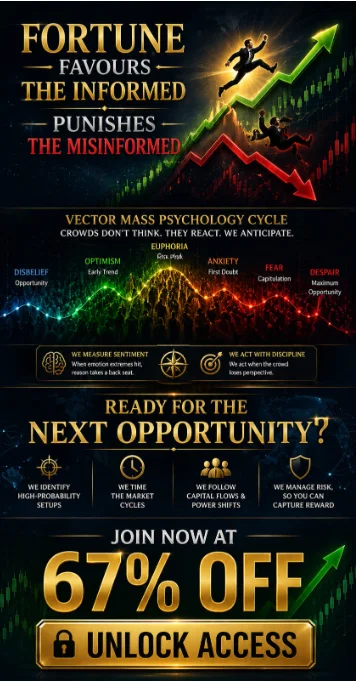
Markets aren’t ruled by rational actors. They’re ruled by emotional cascades, herd hallucinations, and narrative storms. Mass psychology isn’t commentary—it’s the battlefield itself. If you misunderstand it, you don’t participate in markets; you serve them. Enter that arena armed only with linear logic and you will bleed slowly, invisibly—until the losses feel like fate rather than design.
Chaos, Consciousness, and the Currency of Defiance
Escaping financial servitude requires more than resistance—it requires reconstruction. Every financial action encodes belief. You aren’t merely spending money; you’re underwriting the architecture of someone else’s value system. Freedom begins by redefining value outside of fiat terms and into psychic capital: time, sovereignty, attention. Money becomes secondary—a derivative of internal power.
Chaos will follow. The system depends on your fear of disorder. It herds you toward predictability because predictable people are controllable people. But on the edge—where chaos breathes—that’s where freedom incubates. Learn to appreciate volatility. Find rhythm inside noise. In chaos, disparate ideas spark against each other and form strategies that should not work but do. That’s where alpha originates.
The best trades are always paradoxes. The most profitable decisions feel deranged until they become canon. Buy when it feels like betrayal. Sell when it feels like triumph. Understand that crowd psychology never follows a straight path—it breaks, loops, pulses, and snaps. The mob moves through myth, mimicry, and pure adrenaline. Learn to anticipate those emotional hallucinations and move three steps ahead of them.
The Myth of Rational Wealth
The “rational actor” was never a description—it was a leash. It justified resource hoarding by those fluent in its sterile language. Wealth has never been mere stored labor; it is stored belief, stored dominance, stored narrative. Collapse that belief, and value evaporates instantly.
To free yourself, exile the priests of certainty. Study the market’s ruptures—moments when logic malfunctioned and myth overtook math. 1987’s crash. The dot‑com implosion. The meme-stock storm. These weren’t bugs; they were revelations—windows into the underlying code of collective belief.
When value becomes a punchline and capital follows jokes, it signals that belief has outrun fundamentals. The mob has gone reflexive, responding to itself rather than reality. In such an environment, clinging to rationality is like trying to swim with lead shoes. You don’t outthink the market—you out-strange it. You read its hallucinations and surf the collective psyche instead of resisting it.

Escape Velocity: From Reaction to Creation
Financial independence isn’t the summit—it’s escape velocity. It’s the point where you stop reacting to narratives and start generating your own. You operate through sovereign logic rather than fear-driven impulses.
This freedom requires discipline—but a kind rarely taught. It’s the discipline of unlearning. The discipline of ignoring dopamine-driven algorithms. The discipline of resisting quick conclusions and sitting with difficult ambiguity.
This is also intensely practical. Learn a skill that cannot be outsourced. Build systems that survive market failure. Develop mental models resilient to contradictory information. And cultivate boredom—yes, boredom. It is in boredom that insight incubates. You can’t detect asymmetry if your attention is hijacked every waking second.
Step beyond consensus manufacturing. Seek edges where others aren’t looking. Trade with both capital and curiosity. You’re not here merely to optimize—you’re here to rupture, to innovate, to render obsolete the very rules designed to confine you.
Toward a Beautiful, Violent Liberation
One truth remains: financial liberation is never handed over. It must be seized. It demands ferocity, creativity, and restraint in equal measure. You must become something hybrid—part strategist, part trickster, part monk. Know when to advance, when to vanish, and when to change the frame entirely.
This is not self-help. It is self‑sovereignty at full scale. It has nothing to do with budgeting apps or the “right” ETF. It is about who you become once the old maps fail. It’s about the spark you tend during market lulls—the intuition that grows between trades, the joy of understanding something that can’t be cleanly expressed.
Financial liberation is never linear. It is recursive, fractal, and chaotic. It is a dance between destruction and creation. You are not trying to win the existing game—you are growing beyond it. And in doing so, you make its rules irrelevant.