
John Bogle Investing: Add Mass Psychology & Rule the Roost
Aug 14, 2026
John Bogle changed investing by recognising something most investors prefer to ignore: the market does not need to be beaten to build wealth; it needs to be owned efficiently. His low-cost, diversified index strategy strips away much of the speculation, excessive trading and fee drag that quietly erode returns, allowing time and compounding to do what prediction so often fails to accomplish.
But there is an interesting wrinkle. Bogle understood the power of discipline, yet markets are ultimately driven by people, and people are rarely disciplined when money, fear and greed collide. Add mass psychology to Bogle’s framework and the strategy becomes more interesting, because you are no longer simply accepting market behaviour; you are studying the forces that create it.
The Core of Bogle’s Strategy
Bogle’s philosophy rests on a deceptively simple premise: own the market broadly, keep costs low, minimise unnecessary activity and give compounding enough time to work. The genius is not complexity but the removal of complexity, because every unnecessary decision creates another opportunity to make an emotional mistake.
This is where index investing has its structural advantage. Active managers face higher costs and must continually make decisions about what to buy, sell and when to act, while the index investor largely accepts the market as it is and allows the passage of time to become an ally rather than an enemy. The strategy is boring by design and that may be precisely why it works.
Then Comes Mass Psychology
Markets are not machines processing information rationally; they are crowds constantly interpreting, misinterpreting and reacting to information. When optimism becomes contagious, investors begin extrapolating recent gains into the future, valuations stretch and risk becomes invisible. When fear takes control, the process reverses and investors often sell precisely when their emotional discomfort is greatest.
This creates a strange opportunity. Bogle’s discipline protects you from the crowd, while mass psychology helps you understand the crowd.
The distinction matters because staying invested through volatility does not mean ignoring market conditions. It means understanding why the crowd behaves the way it does without allowing that behaviour to dictate every decision.
The Dot-Com Lesson
The dot-com bubble provides an obvious example of mass psychology overwhelming valuation. The internet was genuinely transformative, but investors gradually stopped distinguishing between a revolutionary technology and a revolutionary investment opportunity, bidding up companies simply because they were associated with the new narrative. The technology was real and so was the psychology.
A diversified index investor still suffered when the bubble burst, but avoided the additional danger of concentrating everything in the market’s most fashionable speculation. The lesson is not that indexing makes investors immune to crashes; it is that diversification reduces the consequences of being spectacularly wrong about which individual assets will survive.
Where Technical Analysis Enters
This is where we depart from pure Bogle. Bogle’s philosophy was not designed around market timing, and attempting to turn index investing into a constant trading system defeats much of its original purpose. However, technical analysis can provide a useful risk and sentiment lens without requiring investors to predict every short-term movement.
Moving averages, momentum, volume and other indicators can help reveal when market behaviour has become unusually extended or when selling pressure has reached an extreme. They do not provide certainty, but they can provide context, particularly when technical conditions align with extreme mass psychology.
The objective is not to abandon the long-term strategy every time an indicator flashes. It is to understand when the crowd is becoming irrational enough to create an asymmetry.
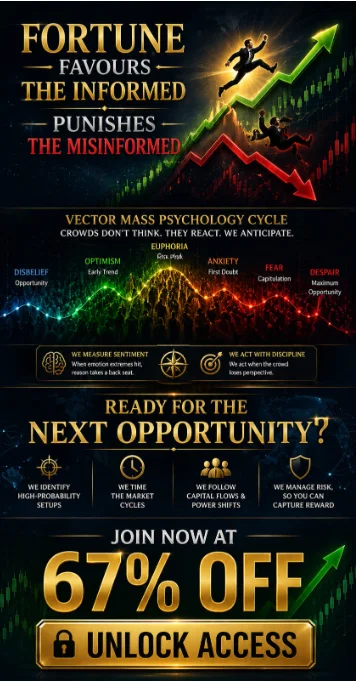
When euphoria becomes extreme, discipline prevents participation from becoming reckless. When panic becomes extreme, discipline prevents fear from becoming paralysis and that is where the three ideas begin to reinforce one another.

The Three-Pillar Strategy
Bogle provides the foundation: broad diversification, low costs, discipline and compounding.
Mass psychology provides the map: it explains why crowds repeatedly move from complacency to euphoria and from fear to capitulation.
Technical analysis provides the timing context: not a crystal ball, but another way of measuring whether momentum, sentiment and market structure are becoming stretched. None of these elements is revolutionary by itself. The edge emerges from the interaction.
An investor who understands Bogle but knows nothing about psychology may remain disciplined yet fail to recognise the behavioural extremes surrounding major market cycles. An investor who understands psychology but ignores costs and diversification may correctly identify the crowd yet destroy the advantage through excessive trading. An investor who relies exclusively on technical signals can become trapped in the endless search for the perfect entry and exit.
Put the three together and the objective changes from predicting the market to understanding the environment in which decisions are being made.
The Real Opportunity
The most powerful market opportunities rarely arrive when everything looks comfortable. They tend to appear when the crowd has become so confident that risk is being dismissed or so frightened that opportunity is being ignored.
This is why market crashes are psychologically fascinating. The fundamentals may deteriorate, but the deeper transformation occurs inside the investor’s mind as confidence gives way to uncertainty, uncertainty becomes fear, and fear eventually becomes capitulation.
The same mechanism works in reverse. After sufficient damage has been inflicted, pessimism becomes crowded, expectations collapse and even modest improvements can produce disproportionately powerful market responses.
This does not mean every decline is a buying opportunity, nor does it mean every euphoric market is about to collapse. The point is to recognise the difference between normal volatility and behavioural extremes.
- Bogle gives you the patience to survive the cycle.
- Mass psychology helps you understand the cycle.
- Technical analysis helps you measure its changing conditions.
That combination is considerably more useful than trying to predict every twist and turn.
Conclusion
John Bogle’s greatest insight was not simply that index funds work; it was that investors routinely sabotage themselves through costs, speculation, impatience and unnecessary decisions. His solution was to remove much of the machinery that encourages bad behaviour and let diversification and compounding work over time.
Mass psychology adds another dimension because the market is not merely a collection of assets; it is a collection of human beings repeatedly responding to one another. That creates recurring patterns. When the crowd becomes euphoric, discipline becomes valuable. When the crowd becomes terrified, perspective becomes valuable. When technical conditions confirm that behaviour has reached an extreme, opportunity can begin emerging from the chaos.
The real advantage is not predicting what the market will do next. It is understanding what the crowd is doing now, while having the discipline to avoid becoming part of it.
Thought-Provoking Reads