
Itzhak Bentov, Stalking the Wild Pendulum, and the Battle for Your Perception
Dec 08, 2025
Introduction: The Engineer Who Dissected Enlightenment and Found a Frequency Map
Bentov never wrote like a man chasing enlightenment. He wrote like a man who had caught it, pinned it to the table, and dissected it with the precision of an engineer who built his own pacemaker with spare parts. Stalking the Wild Pendulum carries that same strange voltage. It reads like a field guide for anyone who wants to understand how perception works when the mind stops pretending it lives in a sealed container. Most people interpret it as metaphysics. It is closer to a warning label. Bentov believed the nervous system does not receive reality. It negotiates it. That negotiation becomes a battlefield the moment someone else learns to tune the aperture faster than you do.
Bentov’s central claim cuts cleaner than people admit. We do not switch between separate realities. We widen or narrow the slit through which reality enters. The world stays constant. The aperture shifts. That idea alone threatens half of modern science because it treats perception as a frequency problem rather than an objective snapshot. Once you accept that the nervous system is adjustable, the boundaries between people lose their solidity. He drew diagrams showing identity as layered fields, each one overlapping more than the last until the highest tier dissolves into full coherence. When people claim this sounds mystical, they reveal they have never looked closely at their own cognition. William James said the mind filters far more than it reveals. Bohm said the universe stores the whole inside every fragment. Bentov fused both ideas and added something more complicated. He said you can train the filter.
From Crash to Classified Files: When Perception Became Infrastructure
The tragedy surrounding his death, the sudden plane crash on the way to Japan, turned him into a myth, but the myth distracts from the deeper point. His work was not fringe. It was inconvenient. Years later, declassified documents echoed his diagrams almost line for line. The Gateway material described the body as an oscillator system. It mapped consciousness as something capable of stepping out of linear time with controlled resonance. It treated awareness itself as infrastructure that could be shaped, extended, and applied. Once Bentov showed the nervous system could widen the perceptual slit, the intelligence world did not meditate on it. It tried to weaponise it. This is the first sign that perception is not a private zone. It is an asset.
Bentov aimed at expansion. Governments aimed at manipulation. Controlled perception became the darker twin of consciousness research. Tradecraft specialists learned that confusion collapses cognitive structure. Contradictions, rhythmic speech, and sensory overload fracture the map the mind uses to navigate. In the gap that follows, the brain grabs the next clear idea as if it were a branch during a fall. The result is a rewrite of internal narrative that the target feels as self-generated. Bentov talked about oscillations. They spoke about compliance. Same mechanism. Different motives. Once you see the nervous system as tunable, there is no ethical floor. There is only the skill of the tuner.

When Tech Became the New Hypnotist: Algorithms That Tighten the Slit
The analogue era kept these methods contained. The digital era scaled them into architecture. Google’s predictive systems, Meta’s manipulation of attention, and the rise of behavioural modelling shifted influence from a manual craft into an ambient environment. Algorithms watch rhythm, cadence, mobility, and micro-decisions, then refine predictions until the system knows your next move before you do. This is where Lisa Feldman Barrett’s work snaps into place. The brain predicts reality first and perceives it second. When algorithms also predict first and present second, the layers merge. Perception becomes a dialogue you did not volunteer for. The environment becomes the message. The system becomes the influence. You become the product.
Pentland’s research shows that behaviour follows patterns nearly as strict as physics. Movement predicts decisions. Communication predicts compliance. Routine predicts drift. Once mapped, these patterns can be steered with tiny interventions that feel natural. A shift in timing. A change in light. A reorder of content. You think you arrived at your conclusion. The system smiles quietly.
The Pendulum Becomes Policy: When Reality Construction Goes Industrial
Now go back to Bentov. Stalking the Wild Pendulum argued that consciousness tunes itself to the frequency landscape, and that tuning determines the slice of reality it can perceive. Neuroscience later confirmed that perception is a construction. Intelligence agencies confirmed that constructions can be redirected. Big tech confirmed that redirected constructions can become business models. The metaphysical became technological. The technological became political. The political became personal. The loop closed without anyone announcing it.
Bentov tried to widen the slit so individuals could see more of the world. Institutions shortened it so populations would see less. This is the contested territory we now stand on. Whoever controls the tuning mechanism controls the frame. Whoever controls the frame controls the story. Whoever controls the story controls the world.
Markets as Nervous Systems: The Investor Who Sees More Wins
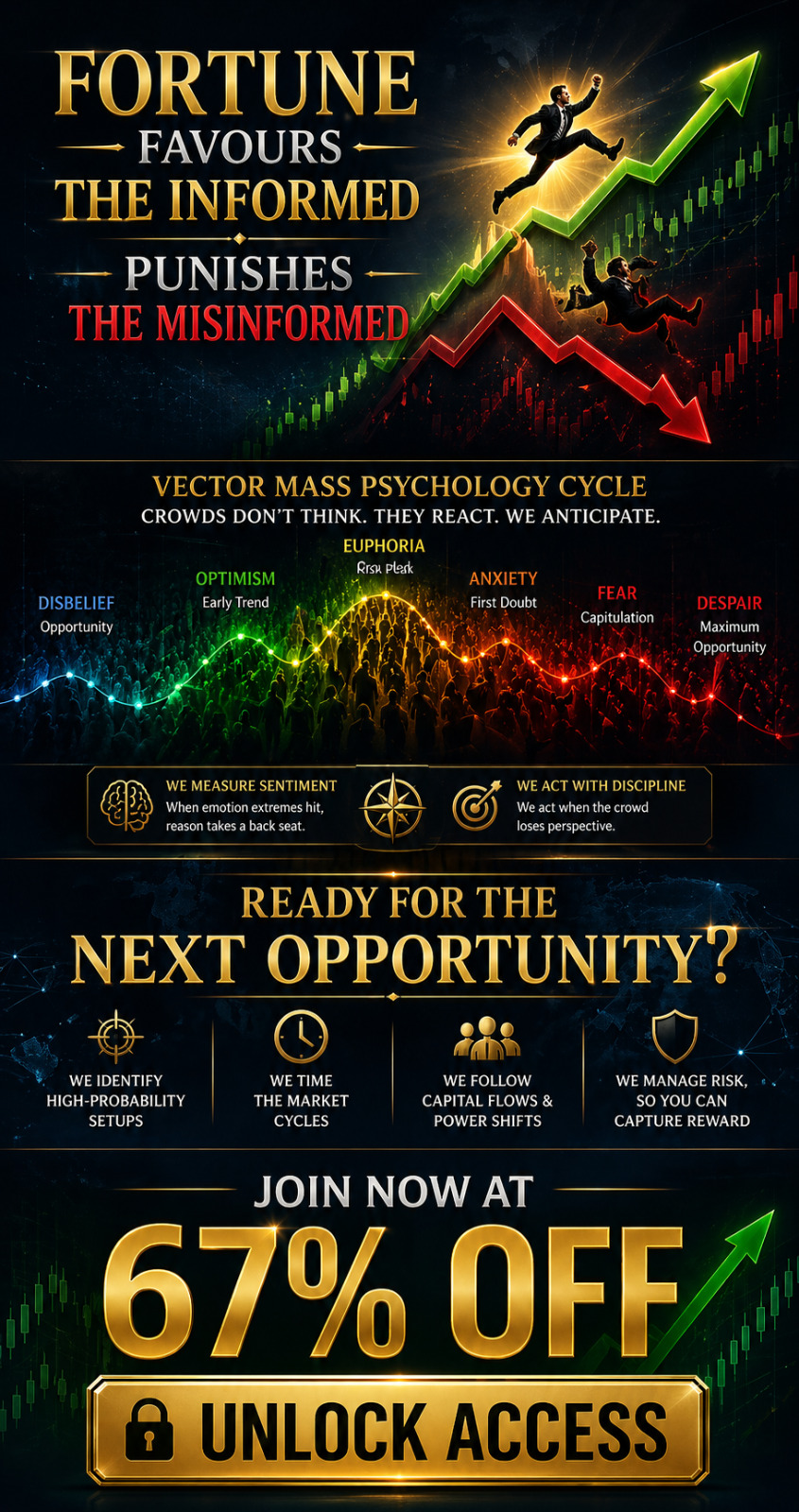
Investing fits into this landscape more than people notice. Markets behave like collective nervous systems. They widen in times of clarity. They narrow in panic. They oscillate, resonate, and entrain. When fear pulses through the crowd, the aperture snaps shut, and traders see only the threat. When greed surges, the slit widens too much and hallucination replaces structure. The investor who cannot regulate their internal frequency inherits the crowd’s blindness. Bentov gives the antidote. Stabilise the nervous system. Widen the frame. See the entire field instead of the flicker. The best investors do not predict the future. They perceive more of the present.
This is the core insight that ties consciousness work to capital allocation. Perception creates opportunity. Distortion destroys it. Most traders operate inside a frame built for them by algorithms, talking heads, and their own fear circuitry. They react before they think. They justify afterwards. And they swear it was logic. A trained aperture does not fall for that loop. It sees the tension building before the break. It detects forced narratives before they collapse. It registers subtle structural shifts that the crowd cannot feel. The edge is not information. The edge is perception.
The String Still Swings: Control the Pendulum or Obey It
Bentov argued that a human being is a finely tuned instrument that few ever learn to play. The same can be said of a mind facing a volatile market or a world engineered by predictive systems. The aperture is adjustable. The oscillator is trainable. Reality is negotiable. And perception is the last frontier of power.
The wild pendulum he stalked is still swinging. The question is who holds the string.
Mental Treats